Donald Trump Delivers the State of the Union Address Tuesday Night
The president will speak to an American public that is souring on his administration’s policies and after the Supreme Court delivers him a rebuke on tariff policy.
By experts and staff
- Published
Experts
![]() By James M. LindsayMary and David Boies Distinguished Senior Fellow in U.S. Foreign Policy
By James M. LindsayMary and David Boies Distinguished Senior Fellow in U.S. Foreign Policy

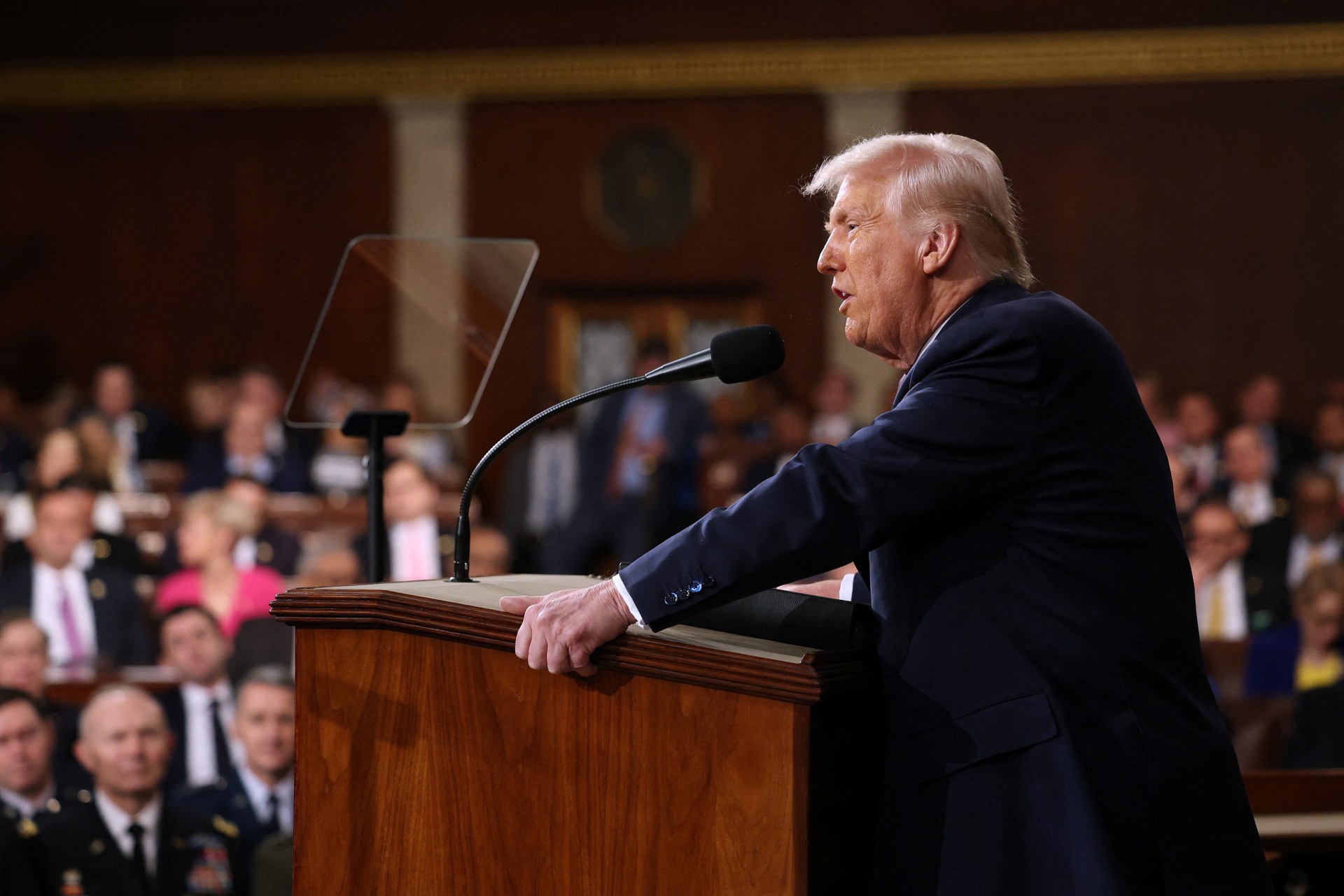
President Donald Trump is set to address a joint session of Congress next Tuesday night at 9 p.m. E.S.T. The speech is his opportunity to make the case to the American public for the policies he has enacted over the first thirteen months of his second term, reverse his sliding poll numbers, and rally Republican voters in preparation for the November midterm elections.
The White House has done little to preview what precisely Trump will say to Congress, though domestic issues will likely dominate. It is a good bet that his speech will go long, and that he will stray from his prepared remarks. Every one of his five addresses to a joint session of Congress has run at least an hour; his speech last March ran for nearly one hour and forty minutes as he frequently went off script. It is also a safe bet that Trump will claim credit for a string of historic successes, leaving the pundits on cable news networks and social media to argue over which are real and which are imagined.
The Political Context
Trump will address the nation with the midterm elections just over eight months away. Control of Congress hangs in the balance. Midterms are seldom good news for presidents. Only in four of the past forty-one has the president’s party gained seats in the House. Republicans now hold just a four-seat margin, so Democrats look primed to retake control. They are even beginning to believe they have a shot at retaking the Senate. Either way, the odds are good that divided government will return to Washington next January.
Another reason for pessimism about Republican chances this fall is Trump’s sagging poll numbers. The most recent Pew poll placed his approval rating at 37 percent, roughly matching the lowest number he recorded during his first term. Polls across a range of outlets show Trump upside down on issues such as the economy, inflation, and crime. Nearly six out of ten Americans say that the country is headed in the wrong direction.
Trump’s advisers have been arguing for some time that the way to reverse his sliding poll numbers and boost Republican chances in November is to make the case that his policies are improving the economy and making life more affordable for average Americans. Joe Biden attempted that strategy in the face of declining public faith in his economic policies. It did not work well for him.
Whatever the merits of telling the public that things are better than they think, Trump has had trouble sticking to that message. In a speech last December aimed at showing that he understood the concerns about the cost of living, Trump instead called affordability a “hoax” dreamed up by Democrats. Not much has changed in his thinking in the ten weeks since then. He told a rally yesterday in Rome, Georgia: “Do you notice, what word have you not heard over the last two weeks? Affordability. Because I’ve won; I’ve won affordability.” But data released this morning shows that the U.S. economy slowed at the end of last year, with fourth quarter growth coming in at just 1.4 percent, down from 4.4 percent in the fourth quarter. Voters may know something the president does not.
In any event, the standard caution about what a presidential address can achieve applies. For all the talk of a presidential bully pulpit, presidential speeches seldom move public opinion.
Tariffs, Trade, and the Supreme Court
Foreign policy experts will be listening to what Trump says—or doesn’t say about the rest of the world. There is no shortage of topics he could discuss. He will almost certainly discuss tariffs. This morning, the Supreme Court struck down his use of the 1977 International Emergency Economic Powers Act (IEEPA), the legal authority he has cited for most of the tariff hikes he has imposed over the past year. Trump bristled at the ruling, saying that he was “ashamed of certain Members of the Court” and calling them “Fools and ‘Lapdogs.’” He is likely to say more on the subject between now and Tuesday night.
The Court’s ruling does not take Trump out of the tariff business. The tariffs he has imposed under other legal authorities remain in effect, and he responded to the Court’s ruling by invoking Section 122 of the Trade Act of 1974 to impose a 10 percent global tariff. But the court’s rebuke of his expansive reading of presidential authority has narrowed his options. Unlike IEEPA, Section 122 tariffs cannot exceed 15 percent and lapse after 150 days unless Congress extends them. The other tariff statutes available to Trump require him to follow potentially time-consuming procedures or limit how much he can raise tariffs. The Court’s ruling also creates major uncertainties about what happens to the trade deals he has negotiated or is in the process of negotiating.
The Court’s ruling is actually the second piece of bad news that Trump received on the trade font this week. Yesterday, the Census Bureau released the numbers on the 2025 U.S. trade deficit. On the plus side, the overall U.S. trade deficit with the world narrowed slightly, largely because the U.S. trade surplus in services continues to grow. However, Trump has historically focused on a narrower trade measure, the balance of trade in physical goods. Here the U.S. deficit hit a new high in 2025. That suggests that Trump’s tariffs have so far not led to a renaissance in U.S. manufacturing. The steady decline in U.S. manufacturing jobs over the past year seems to corroborate this conclusion.
The timing of the Supreme Court’s ruling injects some drama into Tuesday night’s speech. By tradition, all nine Supreme Court justices attend the State of the Union and sit front and center as the president speaks. To show their impartiality, they generally sit stone-faced, applauding only at apple-and-pie moments. When Justice Samuel Alito shook his head and appeared to mouth the words “not true” during Barack Obama’s 2010 State of the Union address, the breach of decorum made front-page news. So the justices can expect to have their facial expressions and body language heavily scrutinized while the president speaks on Tuesday night.
Iran, Venezuela, and More
Trump is likely to discuss Iran. The United States has been amassing military forces in the Middle East for weeks as it has pressed Tehran to limit its nuclear and ballistic missile programs. Yesterday, Trump said that the world will learn in the next “ten to fifteen days, pretty much, maximum” whether he will order an attack on Iran. The timeline could be much shorter than that, however. Last June, Trump issued a statement that he would make a decision about whether or not to strike Iran “within the next two weeks.” Just thirty hours later, Trump ordered the U.S. military to strike Iran’s nuclear facilities. An effort to force a vote requiring Trump to come to Congress for authority in advance of any strike on Iran looks likely to fail. Almost all Republicans oppose the motion, and some Democrats worry that such a vote would undercut Trump’s ability to use the threat of force to strike a deal with Iran.
Venezuela is also likely to merit a mention on Tuesday, if only for Trump to hail the bravery and skill of the U.S. military in capturing Venezuelan President Nicolás Maduro. While many Venezuelans hoped that Maduro’s rendition would lead to regime change, Trump so far has been content with leadership change and “regime management,” as the rest of the Maduro government remains in place. Trump notably did not mention democracy or human rights during his January 3 press conference announcing Maduro’s capture, and he has yet to offer any specific plans to help Venezuelans reclaim their democracy. Indeed, this week, Trump seemingly abandoned the U.S. policy of not recognizing Maduro’s government as the legitimate government of Venezuela, calling relations with the government of Acting President Delcy Rodríguez “a ten.”
Other topics to watch for include U.S. policy toward China, the state of relations with NATO and U.S. allies generally, the actions he is taking to end Russia’s war on Ukraine, what the United States is doing to move the Gaza Peace deal forward, the future of the Board of Peace, and how the “Donroe Doctrine” is targeting Cuba. As always, the issues that Trump ignores or glosses over could be a noteworthy as topics he does tackle. And he may also throw in a topic that few in Washington are talking about, as he did last year when Greenland and Panama featured prominently in his joint address to Congress.
The Democratic Response
As is customary, Democrats will present a response to Trump’s speech. They have tapped Virginia Governor Abigail Spanberger, who took office last month, to deliver the response in English. Senate Democratic Leader Chuck Schumer released a statement saying that “Gov. Spanberger will lay out a clear path forward: lower everyday costs, protect healthcare, and defend the freedoms that define who we are as a nation.”
Meanwhile, Senator Alex Padilla of California will give a response in Spanish. He said that he expects to discuss a “better path” for the United States than Trump is offering costs, “one that lowers costs, safeguards our democracy, and reins in rogue federal agencies.”
One quick prediction: Whatever Trump says, Republicans will praise the speech and Democrat will pan it.