The “European Onion” + China, Brazil, and India Take On MAGA
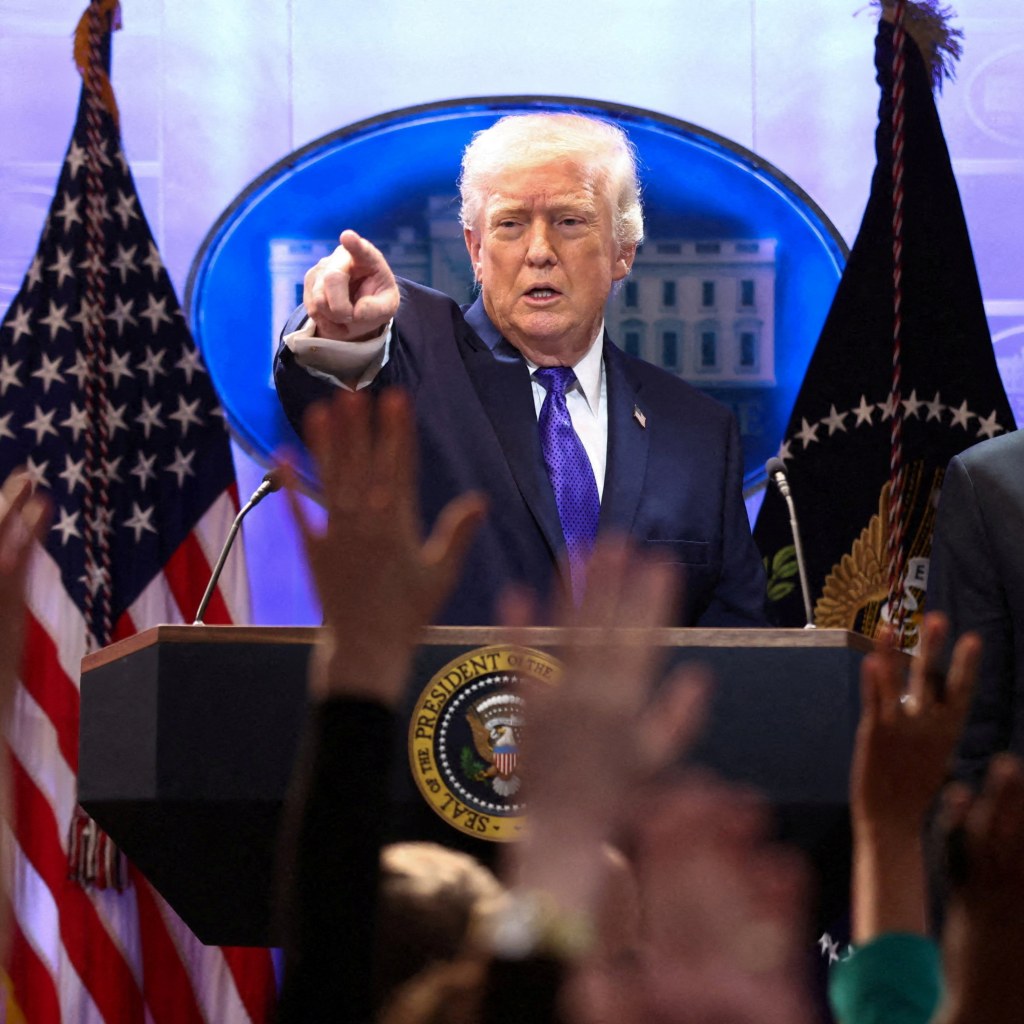
European leaders are at an inflection point. After high-level meetings in Munich and Brussels, they must decide what role Europe will play in the unfolding new world order, politically and economically. Can China, India, and Brazil provide lessons on how to navigate the U.S. trade war? Can a “multi-speed” Europe with less and simpler regulation become a reality? As the world’s second-largest economy, the EU’s choices will shape global growth—and markets are watching.

Published
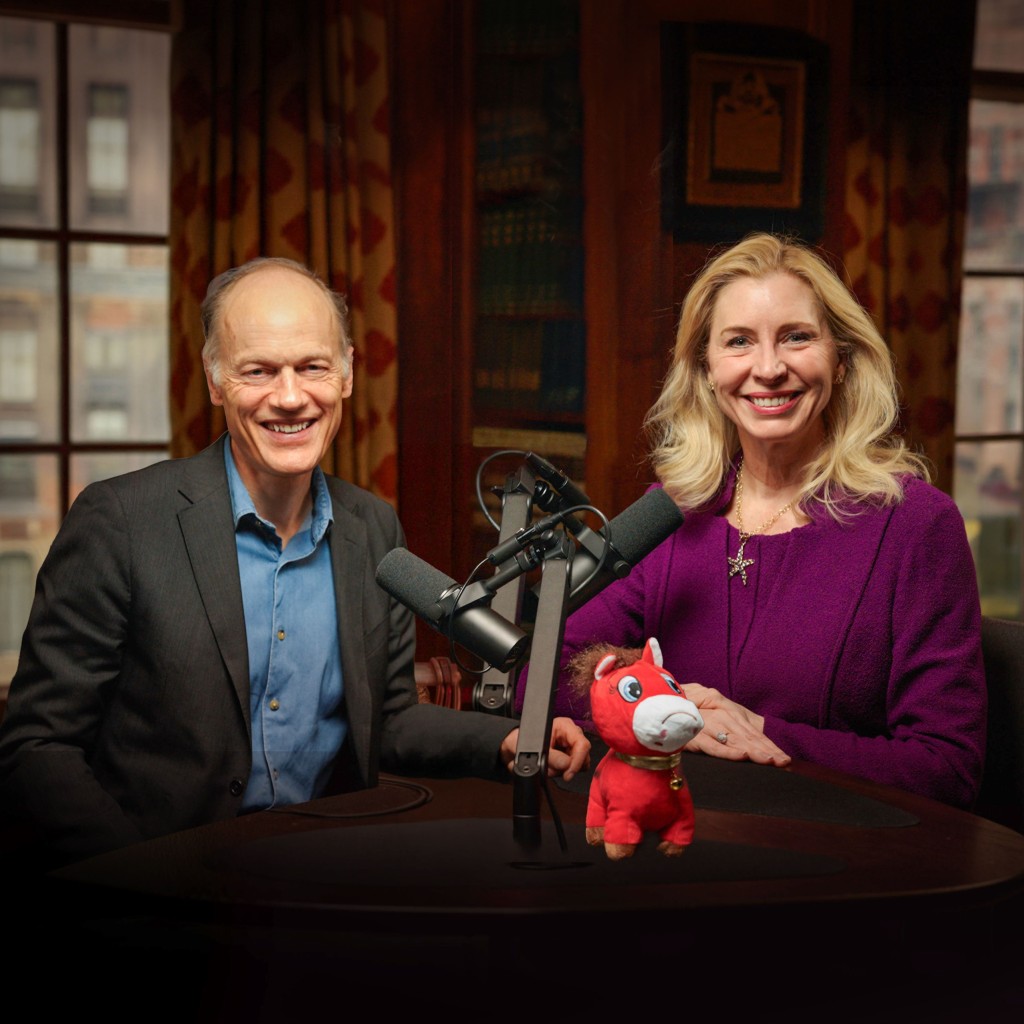
Hosts
- Rebecca PattersonSenior Fellow
- Sebastian MallabyPaul A. Volcker Senior Fellow for International Economics
Guest
- Edward FishmanSenior Fellow and Director of the Maurice R. Greenberg Center for Geoeconomic Studies
Producer
- Molly McAnanyProducer, Podcasts
Supervising Producer
- Gabrielle SierraDirector, Podcasting
Supervising Producer
- Jeremy SherlickDirector of Video
Camera Operator
- Justin SchusterAssociate Producer, Video and Audio
Audio Producer
- Markus ZakariaAudio Producer & Sound Designer
Audio Engineer
- Todd YeagerAudio Engineer
Researcher
- Liza JacobResearch Associate, Finance, Business, and Technology
Transcript
MALLABY:
I’m Sebastian Mallaby.
PATTERSON:
And I’m Rebecca Patterson.
MALLABY:
Welcome to The Spillover. Each week we’re going to take a topic at the intersection of technology, geopolitics, economics, and finance, and look at the ripple effects, how they interlock, look at the spillovers.
PATTERSON:
And Sebastian, today we’re focusing on Europe, right?
MALLABY:
Right. And there’s two big reasons. First is Europe’s been in the news a lot. Europe is at an inflection point. It’s trying to figure out what its position is going to be in the world order, militarily, economically, and so forth. There was the Munich Security Conference just now, and that’s kind of known as Davos with guns. And the Europeans were trying to figure out how they should respond to a speech from Secretary of State, Marco Rubio, which was kind of more polite than the one the year before from Vice President JD Vance, where he talked about civilizational erasure and all that, but actually underneath was pretty much just as tough.
And then there was also the less high profile, but maybe more important gathering of the heads of state in Europe where they got together in a castle in Belgium and they discussed how to make the European economy more modern and dynamic. Maybe that castle dynamism juxtaposition is a bit weird, but that’s how they do things in Europe.
PATTERSON:
Yes.
MALLABY:
And so that’s one reason to be talking about Europe right now. But the other I think is that Europe just is big and important and people may be underrate that sometimes. It’s got a population of 450 million, that’s one third bigger than the United States. It has the second-biggest economy in the world, bigger than China’s in terms of nominal GDP. It’s got the second-biggest weighting in global equity indices. So there are going to be a lot of spillovers coming out of whatever Europe decides to do.
And I just flag one last thing about this before we get into it. I’m looking forward to the last part of the podcast where we’re going to have our council on foreign relations colleague Eddie Fishman, come on with us. Eddie is the author of the bestselling book, Chokepoints. He’s an expert on sort of geoeconomic statecraft, and he’s also the author just recently of a very provocative essay saying Europe should liven up and have the guts to dare to hit the US with sanctions. So I’m looking forward to that.
PATTERSON:
I’m looking forward to talking to Eddie as well. But before we get into it, I want to double down on something you just said, which is the inflection point Europe is at. When I think about Europe’s struggles to reform, they’ve been talking about capital markets union for over a decade, for example, and I think it was Treasury Secretary Scott Bessent who said during the Davos Summit last month that when Europe has a crisis, it usually forms working groups.
And it’s not completely untrue. But when you think about what Europe’s facing today, you have the US, and there’s now real questions of whether it can be the same trusted ally that it’s been for decades. You have China eating its lunch, so to speak, in terms of trade market share globally. And now you have Russia obviously continuing the military conflict in Ukraine, but also sending drones out over developed Europe and kind of flirting militarily with what could come next. So if Europe can’t reform now, when can they?
MALLABY:
Totally.
PATTERSON:
And so I think it’s a great time to be talking about Europe after these meetings and ahead of that next big meeting in March. I think there is optimism priced into the financial markets that Europe can actually get it together this time. After Germany abandoned its debt break, which was kind of its form of a fiscal straitjacket, you have seen money flood into Europe. Now part of that was low valuations, but a lot of it was optimism that if Germany, of all countries, could embrace fiscal spending, maybe they all could and they could drive growth faster.
So last year, we saw the German equity index, the DAX, outperform the S&P by 400 basis points, four percentage points. And if you were an American and you bought Euros to invest in the DAX, when you brought that money home at the end of the year, you got an extra 13% kicker from the move in the Euro versus the dollar. And we’re seeing that trend continue this year. So the DAX, again is outperforming the S&P year to date, the euro’s up a little bit. And I guess the question is similar to the one I think we’re going to discuss next week about AI, artificial intelligence. There’s a lot of hope priced in, now we need the show me.
Can they deliver? Can Europe actually reform quickly enough and by enough of a margin that it changes the dynamic for the country? I think that’s our episode. So we’re going to do this, Sebastian. We’re going to do good cop, bad cop, and talk about the bullish and bearish case for Europe. I think that’ll be fun. And then as you mentioned earlier, we’re going to bring in our colleague Eddie Fishman to talk about his essay recently in The Guardian and see what Europe can learn from other countries that seem to be navigating this US administration more successfully.
MALLABY:
Sounds good.
PATTERSON:
All right, awesome. So you’re going to be good cop since you’re slightly more European than I am, and I’m going to play bad cop. For the sake of argument, I’m actually rooting for Europe. I want Europe to succeed. I’m a big fan. I lived in France, I lived in Italy, I lived in the UK. I love Europe, but we kind of trashed France last week on our podcast, so I think you have the harder job today. Last week you said France stinks, basically, economically, and now you need to defend the European Union. So have fun with that.
MALLABY:
How do I do that without doing a 180?
PATTERSON:
You know what? This is your challenge. Go for it.
MALLABY:
Here’s my riff on this. Okay, so I concede, Rebecca, that Europe has big problems on the macro front, but I contend that it has terrific strengths on the micro front. So what I mean is if you get below the big macro issues of government debt, over regulated labor markets, and you look at the companies, it’s impressive. I follow tech, I go to tech conferences both in the US and in Europe. And when I go to the European ones, I’m impressed by how good they are relative the US. They’re not better, but they’ve caught up. They would’ve been way behind before in terms of ambition, vision, savvy and all that.
And now they’re just not. You go to these conferences, you’ve got companies like Helsing, which is a German defense. Tech didn’t exist four years ago. Now it’s worth 12 billion. You think back to the COVID crisis, we were all desperate for an mRNA vaccine. The first one to get through approvals both in the US and the UK, it was invented in Germany by BioNTech. And that company, BioNTech is now making personalized cancer therapies and it’s worth like 27 billion.
And if you look behind these anecdotes at the macro … I mean, not the macro data, but the data, what you see is in the last 15 years, the number of European unicorns, that is to say private tech companies worth more than a billion dollars, it’s gone up from 10 to 200. So that’s a twentyfold increase. If you look at the amount of venture capital flowing into European companies, it’s gone up over the same period, also just about 20 times.
So the idea that you go to Europe and you say, “Whoa, where’s the innovation? Where are the tech startups? Where’s the dynamism?” That is a totally out of date view. They are there now. And it’s sure the US is still ahead in absolute terms, but the gap is shrinking. And in fact, US share of venture capital deployed has gone down in the last 15 years and some of the shift is in favor of Europe.
PATTERSON:
So Sebastian, I don’t doubt your numbers and I agree we are seeing a lot of innovation in Europe, but I also believe that some of the private equity money writ large that’s gone into Europe over the last couple of years, part of that was just the valuations in the United States had skyrocketed and Europe had some opportunities, but there were also a lot cheaper. So as those valuations start to rise, is that going to slow down some of this investment in these European companies?
MALLABY:
Sure. I mean, look, I think if you’re talking about big companies, whether they’re publicly quoted on the stock exchange, whether they’re like private equity deals, you’re absolutely right. Low valuations in Europe is what drew money in. But when you’re looking at startups, and I admit I’m a bit biased here. I’m looking at startups, stressing them because I wrote a book about venture capital, but when you look at them, the entry point, the valuation is much less important because it’s totally a growth story, right?
PATTERSON:
Fair.
MALLABY:
You’re trying to invest in something that’s going to make 10X your money, 50X your money. Whether you go in at 50% more, 50% less, doesn’t really change the math. Okay? And I’d add one more thing actually, which is that again, looking at the early stage bit, now that you’ve had that momentum build up, it’s just going to build from here. You have Spotify, take, okay? Spotify, by the way, Swedish company worth almost $100 billion, right?
The first 50 or 100 people who joined that company who were inside the rocket ship as it scaled up from zero to huge, that is the most intoxicating experience you can have business. And when you do it once, you want to do it again. So those people are going to go out, they’re going to found another company, they’re going to become venture capitalists, they’re going to mentor new entrepreneurs, they’re going to contribute to the ecosystem. So each time you get a unicorn, it means more unicorns in the future. This is a snowball that’s going to grow.
PATTERSON:
The unicorn waterfall. Yes. Okay. Fair, fair. And then in the big companies in the public space, and now I’m not being a very good bad cop. I’m being a good-good cop, but I would give Europe credit for that. I would talk about ASML.
MALLABY:
Sure, absolutely. I mean, semiconductors are the most strategic product in the world right now. In a world of AI, you need hardware. And the company with a monopoly pretty much on the machines that print the circuits onto the silicon is this Dutch company, ASML. And you can’t make chips without it.
PATTERSON:
I’ll amplify that. It’s not only it has a lot of market share, it is the world’s only provider of this type of lithography. You’re not going to have a phone or a chip or anything else without this one Dutch company, which is pretty extraordinary that we’re even here. But let me take it for a minute, and I will try very hard to be a bad cop for Europe. And I do think last week, we talked about some of the structural challenges for some countries, France in particular in Europe, so demography, population aging, labor force shrinking, their debt levels, which are high, the political inability to really deal with that. But I’d add there’s a couple more structural challenges for Europe in particular.
I think the first one, and I’ve written about this in I think it was a year ago or so in the Financial Times, was just the depth and breadth of their capital markets, financial markets. So in the United States, about 30% of lending for companies comes from traditional banks. 70% comes from everything else. Non-bank financial institutions like venture capital, like private equity or capital markets, just public corporate debt. In Europe, it’s flip-flopped. 70% of lending comes from traditional banks. And what that means is every time there’s a slowdown in the economy, the banks pull back. They’re not going to want to take a lot of new credit risk. And so if I’m a startup and I’m trying to scale, every recession, every dip, my ecosystem is falling behind versus the United States.
And we’ve seen that build over time. So they have to address that. And as I said earlier, capital markets union conversation for over a decade and they’re still not there. So they need to get that together. I’m hopeful. I am hopeful, but they have to fix that. And then the second one is they have to move faster. So they need to be more policymaking functional, shall we say. It’s always a challenge. If you think about the United States, we can barely pass legislation and we’re just one country. The EU is 27 countries. So take our Congress and multiply it 27 times. I’m not surprised it’s slow.
I remember I had an internship a million years ago at the Council of Europe in Strasbourg. It was an introduction to all things European bureaucracy. It was lovely. We had a really nice lunch every day. They had a beautiful sculpture garden, but things did not move quickly. So they’ve got to figure that out. The third thing I’d throw in the mix is the regulatory environment. They need to lighten it and they need to simplify it. If you look at surveys today, I think small and medium-size companies in Europe, they list, more than half list that regulation is the number one obstacle to growth. And Europe knows this. The question is will they have the political ability and will to actually do something about it?
MALLABY:
Right. So I think you’re right about all these macro impediments, but the question we have to ask is, I’ve argued that the micro strengths are going to grow like a snowball. And I think on the other hand that these macro problems, they might be fixed, right? I mean, they might not be there forever. They’ve been there for a long time.
PATTERSON:
Right. Mm-hmm.
MALLABY:
But you do see some change. And for example, you mentioned earlier on, the Germans used to be completely opposed of spending with a deficit. And now they figured out they need to improve their infrastructure, they need to spend more in defense, and they just change their constitution and remove that debt break. So change is possible.
PATTERSON:
Yeah. And one thing that I’m hopeful about is Europe is talking again about working at multispeeds, about an à la carte menu. It’s not all or nothing. It’s different groups can be in with different places. And one of the best anecdotes I’ve heard all year has to come from Belgium. The prime minister, I think misheard another policymaker say European Union and thought he said European onion. And so now I can’t get it out of my head, and you’ve probably never eaten here, but growing up, I ate at this place called Outback Steakhouse all the time, and the best thing on the menu is the onion, because you open it up, there’s all these layers, these pieces, and it’s delicious.
MALLABY:
What’s the calorie count on that thing?
PATTERSON:
I think it’s 1,950 for one. Yeah, it’s not … So maybe Europe isn’t the healthiest thing for us, but if we allow it to operate with more layers, more choices, maybe it can actually work. And so I think this idea of inner and outer layers for Europe, back in 2011, 2012, they talked about it as well, and I think they quickly ruled it out because they were so nervous A, about the credit spreads. If I’m Italy or Portugal or Spain, my credit spreads are already widening versus my core peers. If suddenly there was an outer Europe, maybe it’s like the first step to getting rid of them. So they dismissed it.
MALLABY:
And I think it was sort of a principled argument that they wanted a strong executive in Europe, and that meant that the European Commission had to administer one set of rules for all of the member states, and they didn’t want us to mess around doing à la carte, you can do this, I’ll do that. And that was sort of a principled vision, but it was also a terrible vision because it meant that if two or three countries refused to go along with some new rule, you couldn’t have the rule.
PATTERSON:
Right.
MALLABY:
So it was like a veto system.
PATTERSON:
And now it feels like they’re sort of sliding into that. I mean, they’ve made some decisions recently where a few of the eastern Central European countries have just abstained or opted out. So maybe they’re moving in that direction. Maybe that would unlock some of the reforms in Europe that we think they need to have in order to justify the increasing valuations on some of the publicly traded companies at least.
MALLABY:
And I’d add also at a high level, if you look at Europe over the last 15 years, a couple of things have happened. One is that the story that you had a strong core, which was France and Germany, sometimes Italy was counted and they looked down their noses at the others. Portugal, Italy, Italy, when it was having economic trouble.
PATTERSON:
Greece.
MALLABY:
Greece, Spain, they were called the pigs, and that tells you what people thought of them. So that contempt sort of flipped on its head because now Spain has a stronger economic growth picture than France, and that ought to tell the Europeans that there’s strength in solidarity. Sometimes your particular country will go through a good period. Other times the other guys will be going through a good period. If you band together, you even out those lifts and dips. So that’s one thing.
The other thing that Europe has been through a bunch of crises in the last 15 years. There was the Euro financial crisis. Greece almost left the Euro. I remember doing events with the Council on Foreign Relations and sort of asking the panel, and maybe you were one of the panelists actually.
PATTERSON:
Grexit, we talked about Grexit.
MALLABY:
Right. And how many members will there be of the Eurozone in a year’s time? And people would kind of say, “Well, I think three are going out or two are going out.” Zero went out. Why? Because actually Europe found a way to act together through the European Central Bank to buy the debt of the weaker economies. That had been taboo, and they broke the taboo. Then up comes the next crisis, which is COVID. There had been a taboo on issuing joint European debt. Guess what? They issued joint European bonds to fund the recovery from COVID.
Then comes the Ukraine war. There had been pretty much a taboo on strong geopolitical action by the European Union, but now you have Europe completely underpinning Ukrainian defense. Under the Trump administration, the Americans are not contributing money to the defense of Ukraine. Europe is doing all of that. So a bunch of things have happened which do show not only that Europe is changing, but that it can act together. So maybe this time might be different.
PATTERSON:
I mean, I agree they’re capable of it, but we also see for example, the trade agreement that they just reached with Mercosur with Latin and South America. They still have to add a couple extra layers, a couple extra steps to appease farmers in certain countries. Or capital markets union, again, they’re studying it, they’re thinking about it, they’re working, grouping it.
The examples you hit are spot on. Can they do these next steps? Can they do them quickly enough? And to your point, the unity I think is important. But if they’re going to make the next progress, they have to make to be number two or number three on the world stage, I think they probably have to have the layers. I think they need the blooming onion. We’ll see, we’ll see.
MALLABY:
Maybe just to wrap here, I’m going to bring in one more example of something which I think is a glimmer of hope here, which is this idea of the 28th jurisdiction. There are 27 members of the EU, but there’s a talk now of allowing a company to register in a 28th fictitious unified jurisdiction. You can do it online. The company can be registered in 48 hours, and then it gets some rights to operate across the whole of the EU. Now there’s still going to be regulations in each country, and that company might be facing obstacles. It’s not a silver bullet, but it is progress, and that’s something I’m going to be watching.
PATTERSON:
Yeah, that’s a good marker. Well, let’s bring in our colleague, Eddie. He’s going to talk to us about some of the choke points that Europe’s facing dealing with the United States, how other countries are handling it. I know you and I have thought about choke points as well. I know you think about leverage too.
MALLABY:
Yeah, I agree with you about the financial leverage. On the tech side, the one I wouldn’t recommend to Europe is hit the American tech companies that operate in Europe, because European consumers want those products. And if you say cut off AI models that are being served by Google, by OpenAI to European consumers, that’s just not good for Europe. So I wouldn’t recommend that. I’ll be interested to see what Eddie might say about that. I think the thing that could be a proper threat is using ASML. If you say, “Listen, you can’t make chips unless we supply these lithography machines,” that could be an interesting lever.
PATTERSON:
All right. Well let’s bring Eddie in and see what he has to say about all this.
MALLABY:
Great.
PATTERSON:
Just awe promised, we’d like to bring on Eddie Fishman now. He’s a senior fellow here at the Council on Foreign Relations and author of Chokepoints, American Power in the Age of Economic Warfare. It’s a must read. Eddie, come on and join us. Hello.
FISHMAN:
It’s great to be here. Thanks for having me, guys.
PATTERSON:
Yes. Nice to have you here in the Rubin Library.
FISHMAN:
Well, beautiful setting.
MALLABY:
I think we’re lucky because last time I tried to get you to an event here at the council, you said you were in Calgary, Canada, so we’re lucky that you’re here.
FISHMAN:
Look, Calgary has a bad rap. They say it’s really cold, but it was actually 20 degrees warmer there than it’s been in New York. So I was considering staying, but my wife said I had to come back.
MALLABY:
And we wanted you to come back.
PATTERSON:
Yes.
MALLABY:
Because we wanted you to explain, right? You’ve just written in The Guardian that Europe should consider putting sanctions on the United States. Is this for real?
FISHMAN:
Look, what I tried to do was to look at the countries that have dealt with Trump’s economic coercion most effectively. And there are really three that came to mind. It was India, Brazil, and China. And when you look across the three of them, and I know from last week, Rebecca, that you like alliteration. There are really three things that each of them did that I think were effective in terms of making Trump back down. It was resolve, resilience and retaliation.
Resolve is actually arguably sort of the foundation of it all because what you need is can you steal your population to bear some short-term pain. And Prime Minister Modi of India, I think is sort of the perfect encapsulation of this. Last August when Trump imposed a 50% tariff on India, instead of saying, “Okay, we need a rush and get a deal,” the way that the Europeans did a month earlier, Modi said, “We are going to bear whatever pain it takes and we are going to be resilient to this.” And what happened was Indian people rallied around him. You had spontaneous boycotts of American products. You had exporters from India say that they weren’t going to cut prices in order to continue to sell into the US market. And I think what it did was it demonstrated to Trump that he’s actually dealing with a partner that wasn’t just going to fold the way that the Europeans and the Japanese would.
And then resilience I think is also important. This really comes down to adaptation. Can you take the exports that you’d previously sent to the United States and send them elsewhere? Brazil in many ways captured this perfectly. Similarly, was also hit by a 50% tariff from the US, which by the way is remarkable that India and were basically the two most heavily tariffed countries by the US last year in the world. And instead of folding, they found alternative trading partners. And if you look at the data last year, Brazilian exports to the US collapsed, but their overall exports ballooned, and they actually had the best year they ever had for exports.
And so it showed that this is what strategists called deterrence by denial, showing Trump that they actually have alternative options and that even if they were going to whack Brazil with a lot of tariffs, it wouldn’t make them full. I think the most controversial part of the piece, and you sort of touch upon this, Sebastian, is the third element which is retaliation. And I think the best demonstration of this was how Xi Jinping responded to Trump’s tariffs in April of last year. The most important geoeconomic event of 2025 was not Trump’s reciprocal tariffs, it wasn’t Liberation day, it was actually the Chinese export controls on rare earths to the United States. Because what it did was it showed Trump that China actually had substantial cards to play and look, it’s reversed basically almost a decade of US hawkish policies on China.
PATTERSON:
So I want to dig into your alliteration a little bit and let me start with resolve, because one of the things I’m wondering about, you have 27 members of the European Union. Can you get resolve across all these countries? Maybe it’s fine if Hungary doesn’t go along with it, but what if part of the core doesn’t? We just saw that Italy’s Meloni is joining President Trump’s Board of Peace. Now as an observer, not a member, but still it doesn’t suggest a lot of resolve. Do you worry that you might lose a member of the core and then that process doesn’t work?
FISHMAN:
Definitely. And look, Rebecca, I think you’ve hit on the key issue that Europe faces. Europe has substantial economic power. I think, Sebastian, you captured this. It’s the second-biggest economic power in the world after the United States. We don’t often think of it in those terms, but it’s quite a capable actor if it can act with one voice. The challenge is splits within the EU. Oftentimes when I’m having these conversations, people bring up Hungary and they say, “Well, isn’t Viktor Orbán going to be a spoiler?” When I was in government and we were worried about would the European Union renew Russia sanctions every six months, there was always concern about Hungary and Slovakia.
I never actually bought that. I think it really does come down to the core. Do you have the Germans, the French, and to a lesser degree the Italians aligned? I think clearly Emmanuel Macron has come out and said, “We need to be ready to use this anti-coercion instrument if Trump threatens us again.” Merz has sort of been a little bit more wishy-washy. He was very much against it last year. I think he’s started to slowly come around. And I think Meloni also is in a similar spot. Look, both Germany and Italy have more dependencies in terms of their exports to the United States than other European Union member states do. But look, their actual export dependency in the US is very similar to India. So it’s not out of the question that they would do that.
PATTERSON:
That’s a great point.
MALLABY:
It’s sort of interesting that right now as we speak, Macron is in India leading a big trade delegation trying to drum up export opportunities for France to India. So that speaks to your Brazil example, how you hit back. I’m curious, what do you think about this question of US tech firms operating in Europe? Is that a point of leverage for Europe or would that just be harming Europe’s own economy if it restricted US tech operators?
PATTERSON:
Yeah, I saw recently the French government is actually trying to replace Microsoft systems within the government with a homegrown alternative. I didn’t know they had a homegrown alternative that could do that, but it does feel like this would hurt America a lot. Is it doable?
FISHMAN:
Oh, I think it’s a huge point of leverage, and I think the clearest sort of evidence of that, the tell if you will, is look at how the Silicon Valley tech companies complain every time the European Union comes down and finds them. Right? I mean, the fact that you have this alignment between Silicon Valley and MAGA in terms of being anti-EU really comes to show that Silicon Valley really does depend on revenues in Europe. I think Meta earned almost a quarter of its revenues last year in Europe.
So if you think about the fact that, and you would know this better than I do, Rebecca, most of the growth stores in the United States right now is driven by this magnificent seven, right? It’s all the tech companies. And if there was even a hint that their revenues in Europe were going to go down, not to zero, because obviously that’s not credible, but even by a little bit, what would that do to stock market valuations in the United States? And I think if we’ve seen the Achilles heel of American economic warfare, it’s that Trump has a very low tolerance for even small dips in the stock market.
PATTERSON:
Yeah, we have definitely seen that in 2025. And I think this year with the midterm election in November, that tolerance for pain is probably even less. He needs a strong stock market and a strong economy to help his party in November. I have one more question. When you talk about retaliation using points of leverage, we mentioned earlier, ASML, the Dutch company that makes this cool lithography, but it’s one thing for China to use rare earths and companies because it’s not free market capitalism, it’s not a democracy. I don’t even know who it would be. The commission, the council? Who goes to ASML and says, we need you to threaten America? I’m not sure ASML would be keen to follow along.
FISHMAN:
Oh, sure. You’re always going to get pushback from companies, but the US faces the same pushback. Look at NVIDIA complaining about export controls or the banks used to complain about sanctions, but over years and years of being fined by the US government for violating them, they eventually got into order. I think if you look at European power, it’s actually quite clear in terms of where they’re powerful and where they’re not. The competencies, as you call it in EU speak, that are done at the EU level, like competition policy, like digital services, regulation, the EU is a juggernaut, right?
I mean, we all click through these privacy things in the US because of GDPR. It’s not because of a regulation in Washington, it’s because of something Brussels did. On areas where they act as 27 member states and you need unanimity, they’re incredibly weak. Thankfully, this anti-coercion instrument is fundamentally done by qualified majority voting. So you can actually have just a majority of EU member states that theoretically could come together and at the very least, impose some export taxes, for instance on ASML sales to the United States.
MALLABY:
Right. And the more Europe moves towards that multi-speed system, the more things it can act on collectively. Even if it doesn’t have a majority, I mean overall unanimity, it can do it by majority.
FISHMAN:
Exactly. And I think that’s critical for the EU to be successful. We’ve seen that in areas where you need all 27 member states and a single member state can raise their hand and say, “No,” you’re never going to get anything done.
PATTERSON:
Correct.
FISHMAN:
I mean, look at the Euro. Would the Euro of ever launched if you’d required every single member state to adopt it? Of course it wouldn’t have.
MALLABY:
The US Senate has the filibuster. The Europeans have the filibuster on steroids.
FISHMAN:
That’s exactly right.
PATTERSON:
Yes, yes. So I have one more point of leverage. I think we have to bring up, Sebastian, with Eddie. There’s a small event happening in the US later this year, and I think about the high profile nature of the event. I think about the money tied to this event, and I think about who attends. I think Europe has another point of leverage that we should talk about. I’m guessing you know what I’m talking about because of your smile.
MALLABY:
It’s got to be the World Cup.
PATTERSON:
Exactly, right. So I actually had an interview earlier this week with Swiss Television of all things, and they were saying, “Well, do you think people will boycott the World Cup?” And honestly, it hadn’t crossed my mind at that point. So is football or yeah, football, American soccer, whatever we want to call it, is that a point of leverage? Is it a choke point?
FISHMAN:
Look, I would be surprised if the Europeans would go there. I think to the extent the Europeans boycott the World Cup, it’s not going to be because of Trump’s economic coercion. It’s because I think the tickets at MetLife Stadium are going for $40,000 a pop.
PATTERSON:
Ouch.
FISHMAN:
So I don’t know if anyone really can afford those anymore, unless you’re an oligarch or something like that.
PATTERSON:
The Board of Peace.
FISHMAN:
Yes.
PATTERSON:
They can go.
FISHMAN:
Maybe that’s a perk for joining it. But I think one just key point here, because look, those things are good in terms of spontaneous boycotts, and I think they sort of help with the resolve element. But ultimately, if you want to get Trump to back down and respect the Europeans, it’s about not saying that the US is not more powerful than Europe. Clearly America has more power, but the US-European relationship is not one of one-way dependence. It’s not just Europe that’s dependent on the United States. It’s actually one of interdependence.
And so the key question isn’t so much, can the US impose a bigger hit to European GDP than Europe can impose on the US? It’s, can they actually absorb pain better than the United States can? And what both China, what India and Brazil have shown is that when it comes to pain tolerance, that’s really the weak point of the Trump administration.
MALLABY:
Yeah. I’m part of a WhatsApp group where with a bunch of European friends, and they were all responding to the Munich Security Conference. And in particular, the debate was Rubio, the Secretary of State shows up, he says some pretty aggressive things, albeit more polite language, and then everybody gives him a standing ovation.
PATTERSON:
Yeah.
MALLABY:
So people on this WhatsApp group are saying, “What is that? He insults us. He says that we have to subscribe to this blood and soil nationalism, and then we applaud that. What’s going on?” And my answer is, clap loudly, but carry a big stick. And you need to develop your hard power or your economic power, and then you can clap, whatever. It doesn’t matter, but at least you can hit back when you need to.
FISHMAN:
I think that’s right. And I think also if you look at Modi, Lula and Xi, it’s not that they’ve poked Trump in the eye and tried to make him look bad. They’ve actually played nice with Trump publicly. It’s what they’ve done from a material standpoint that’s actually made the difference. So I totally agree with you, Sebastian.
MALLABY:
Terrific.
PATTERSON:
I think that’s a perfect way to end this. Eddie, thank you so much for joining us today.
FISHMAN:
Yeah.
PATTERSON:
It was great to have your perspective here, and we look forward to having you back.
FISHMAN:
My pleasure. And I’m so excited to listen to the Spillover every single week. Thank you.
PATTERSON:
Thank you.
MALLABY:
So Rebecca, let’s see if we can go back through the conversation quickly. I’ll give you my wrap up. Three quick points. First, Europe has a lot of microeconomic strengths. Some very innovative companies, a good position in the semiconductor supply chain. Secondly, though it does have serious macroeconomic challenges, history would suggest that it doesn’t always fix these challenges. But on the other hand, recent events, the arrival of the multispeed idea, the ending of the veto, it could be that it makes some progress on the macro challenges.
And finally, thirdly, as Eddie explained to us, Europe has potential to operate with a lot more geo economic punch, putting sanctions on the US if it needs to, or at least threatening them by using whether it’s financial sanctions or sanctions on US tech companies operating in Europe or maybe through the semiconductor ASML supply chain.
PATTERSON:
Yeah, I feel like we landed on a, the optimism in markets is probably justified.
MALLABY:
I agree.
PATTERSON:
Which that’s nice, ending on a happy note. And speaking of happy notes, I know we want at the end of every episode of our podcast to have something fun or interesting or entertaining, weird that we’ve read or seen or done that week. So mine this week has to do with the wonderful world of crypto and digital assets. So in that broader ecosystem, I noticed something this week and I’m still trying to get my head around it. So Polymarket lets you now make bets for five minutes. You can actually put your money down, and if crypto goes up and you voted up, you make money. If it goes down and you voted up, you lose. Five-minute bets. In the first three days of this market, the volume was $67 million in three days. People just doing coin tosses up or down every five minutes. They’re going to launch a one-minute market.
Anyway, I guess you do it while you’re on the subway. You just bet, bet, bet, bet. If you look at Polymarket and then Kalshi, which is the other big prediction market, just in the last week, their volume has been well over $4 billion. So the growth in these things is parabolic. And again, I’m getting my head around it, but I keep thinking, okay, we’ve got a volatile, illiquid, lightly regulated market. To me, that’s going to attract a lot of high school and college-age kids, and probably a lot of hedge funds looking for alpha. So I’m curious where this thing goes.
MALLABY:
That is crazy. I mean, that is really the ultimate gamification of investing. Dopamine hit after dopamine-
PATTERSON:
I’m not sure if you even call that investing, but yes, it’s definitely a game for somebody.
MALLABY:
It is. Okay, so my subject of the week, I am going with frog poison.
PATTERSON:
Okay. All right. All right. Bring that to Spillovers and global macro for me, Sebastian. You got me.
MALLABY:
So there had been the death two years ago of the Russian democracy campaigner, Alexei Navalny in a far off freezing cold detention camp in the north of Russia. And just recently we learned that the poison that seems to have killed him comes from the poison dart frog from Ecuador.
PATTERSON:
Okay. Of course it does. So
MALLABY:
This is not just grim. It’s completely bizarre. You’ve got these Russian goons, right? They’re sitting there saying, “How can we dispatch this guy Navalny? I know what. We will import amphibian tissue from tropical Ecuador all the way to the Arctic Circle. That’s how we will do it.” I mean, it’s surreal. Come on.
PATTERSON:
Yeah, it’s straight out of a novel.
MALLABY:
Well, it’s proof, I think, that if you want to see reality being weirder than the spies out there in the movies, that’s it.
PATTERSON:
Okay, well, I can’t top that and I’m not sure I want to. So we’ll thank Eddie again when we see him later on today. And in the meantime, I just want to say thank you to everyone for joining us at the Spillover.
MALLABY:
Thank you to Eddie. And thank you to you too, Rebecca.
PATTERSON:
And now we’re going to read some credits. Yes?
MALLABY:
Right.
PATTERSON:
All right. Your turn this week. Have fun.
MALLABY:
Oh. For resources used in this episode and more information, visit cfr.org/podcasts/spillover and take a look at the show notes. If you have an idea or just want to chat with us, email [email protected]. Be sure to include The Spillover in the subject line.
This episode was produced by Molly McAnany, Gabrielle Sierra, and Jeremy Sherlick. Our video editor is Claire Seaton. Our sound designer and audio producer is Markus Zakaria. Our camera operator is Justin Schuster. Our audio engineer is Todd Yeager. Research for this episode was provided by Liza Jacob and Daniel Hadi.
The Hook: Europe wields under-appreciated microeconomic strengths but faces significant macroeconomic challenges. On the micro side, it is home to critical and innovative firms that sit at the heart of key supply chains, an advantage that markets may undervalue. On the macro side, however, slow growth, gridlock, fragmented capital markets, and fiscal limitations have long held the region back. The incentive to get creative so Europe can grow faster and leverage its massive economy is substantial.
The Spillovers: European equities outperformed U.S. peers in 2025 for the first time in many years. Attractive valuations, hopeful sentiment around fiscal stimulus, and a desire to diversify away from the U.S. have helped propel that trend into 2026. For such optimism to be sustained, however, Europe needs to reform and better negotiate with the U.S., possibly taking a lesson from China, Brazil, and India.
The Spillover is a production of the Council on Foreign Relations. The opinions expressed on the show are solely those of the hosts and guests, not of the Council, which takes no institutional positions on matters of policy.
Mentioned on the Episode:
Edward Fishman, “Want to stop Trump bullying your country? Retaliate,” The Guardian
“MEPs propose new legal framework for innovative companies,” European Parliament